
Who Are the Latina Astronauts and Professionals Shaping the Future of Space Exploration?

As NASA returns to the Moon, Latinas are helping shape the future of space. From Ellen Ochoa to Diana Trujillo and Lili Villarreal, their impact highlights the need for more Latina astronauts and Latina in STEM.

Who Are the Latina Astronauts and Professionals Shaping the Future of Space Exploration?

Since the historic moon landing of 1969, every inspired child wanted to be an astronaut when they grew up. However for Latina girls, it seemed that becoming Latina astronauts would have seemed nearly impossible as the pipeline for STEM (Science, Technology, Engineering and Mathematics) education and NASA (National Aeronautics and Space Administration) models of representation didn’t really exist until 1993 when the United States presented a flight crew for the space shuttle Discovery. 

Thirty years prior to the 1993 Discovery flight, in 1963 a Russian woman became the first woman at 26 years old to orbit the Earth 48 times over almost three days and to this day remains the only woman to have completed a solo space mission. 

The United States did not have its first woman astronaut in space till Sally Ride on June 18, 1983. She broke gender barriers in STEM as a mission specialist, she operated the robotic arm to deploy satellites. A limited series titled The Challenger, starring Kristen Stewart as Ride is currently in development.  In the 1980s, we saw racial barriers break with the first Black male, the first Asian male and first Hispanic male astronauts for the United States.

It took another decade, in the 90s, to see Black, Latina and other women of color astronauts join flight crews in space exploration. Dr. Mae Jemison made history as the first African American woman to travel into space, launching aboard the Space Shuttle Endeavour on September 12, 1992, as a mission specialist on STS-47. 

Finally in 1993, nearly thirty years after the first woman in space, Latinas are represented by Dr. Ellen Ochoa who became the first Hispanic woman to orbit the Earth and now a new Latina generation follows in her footsteps. 

What Are The Challenges Latinas Face In STEM?

Despite more Latinas making great progress in the field of STEM (Science, Technology, Engineering, Mathematics), there are still systemic barriers to face in order to push for diversity, inclusion in the study and pursuit of careers in space exploration and space engineering. For instance, the US Equal Employment Opportunity Commission shared that only 5.7% of NASA’s workforce is Hispanic.

Educational access continues to be a fundamental limitation: women amount to less than 35% of researchers worldwide according to UNESCO, and the OECD claims that women tend to choose disciplines like life sciences but not many pursue career paths in engineering, computing, and physics. Part of that could include false narratives and stereotype threats about women and the innate aptitude, interest, or competitive nature required for success, according to studies. Despite evidence showing that girls perform as well as or better than boys in science and math subjects.

When we factor the socio-economic upbringings of a majority of U.S. Latinas and Latin American women living in countries where access and funding of education is very low, the pipeline to STEM related careers is severely restrained. 

Today several initiatives exist to feed that STEM pipeline, specifically for young Latina girls, Latinas in STEM Foundation founded by MIT alumnae, Latinitas, Technolochicas, Latinas Leading Tomorrow (Latina Labs), Seeds of Success (Ciencia Puerto Rico) and many more. 

Many of these organizations engage parents and provide mentorship, and culturally relevant role models and their stories like that of Ellen Ochoa. 

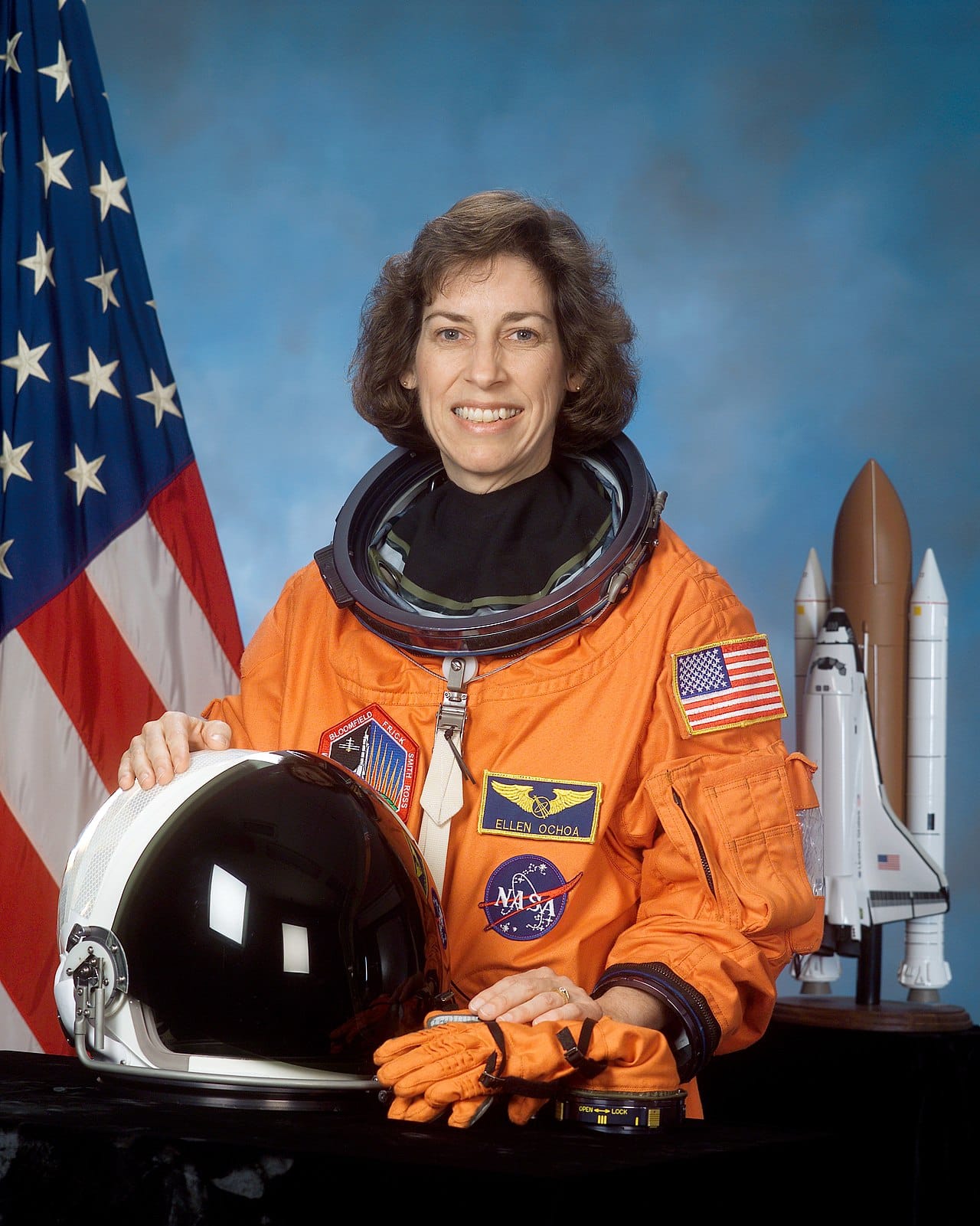
Ellen Ochoa, The first Latina Astronaut in Space

The First Latina Astronaut - NASA - Ellen Ochoa (via Wikipedia)

Born in Los Angeles, Ellen lived her childhood in the sixties along with her four siblings. Her father was also brought up in California, but his parents originally came from Sonora, Mexico. Ellen’s family didn’t have any college education, but her mother went to university to encourage her children to do the same.

As a young Mexican-American girl, Ellen was in love with math and science but never imagined that being an astronaut was a career she could actually pursue. In fact, the thought of studying music had crossed her mind (being a talented classical flutist herself). 

It was learning about women scientists like astronaut Sally Ride that made up her mind, so she went to college at San Diego State University to study physics. As if that hadn’t been enough, she then was accepted and attended Stanford University to get a Masters of Science and a Ph.D. in electrical engineering. 

“Sally Ride flew when I was in the middle of getting my Ph.D., and that made a huge difference. Seeing her in space and learning that she had been a physics major and attended Stanford, where I was working on my doctorate, helped me to see all those things we had in common, and think, ‘Well, maybe this is something that I could do, too,’” said Ochoa in an interview with El País English.

After becoming a doctor, she took a posting at Sandia National Labs in 1985 and at NASA’s Ames Research Center after that. She applied to the NASA 1987 Astronaut program but didn’t make the cut, but that didn’t stop her from getting her pilot’s license and patenting three key inventions related to optical systems. Ellen pushed through and was chosen as the Chief of the Intelligent Systems Technology Branch at Ames, where she oversaw a team of 35 people researching computer systems for space missions. Finally, she was invited to join the astronaut program in 1990, becoming an astronaut a year later.

The STS-56 mission in 1993 was the first of four exploration missions Ellen took part in at NASA. Fun fact: always a music lover, she played the flute aboard the space shuttle for the other members of the crew! Ochoa was also involved from the ground in two other missions, where she captured two satellites in orbit. All her hard work earned her the post of Director of Johnson Space Center from 2013 to 2018, being the first Hispanic woman astronaut to do so. But more importantly, her trajectory was honored by Mattel with her own Astronaut Barbie doll!

Dr. Ochoa’s dedication has paved the way for more Latinas to embark on a journey among the stars. Now Latinas are in the STEM pipeline and making their childhood dreams come true.

How Did Diana Trujillo Go From Colombia to NASA?

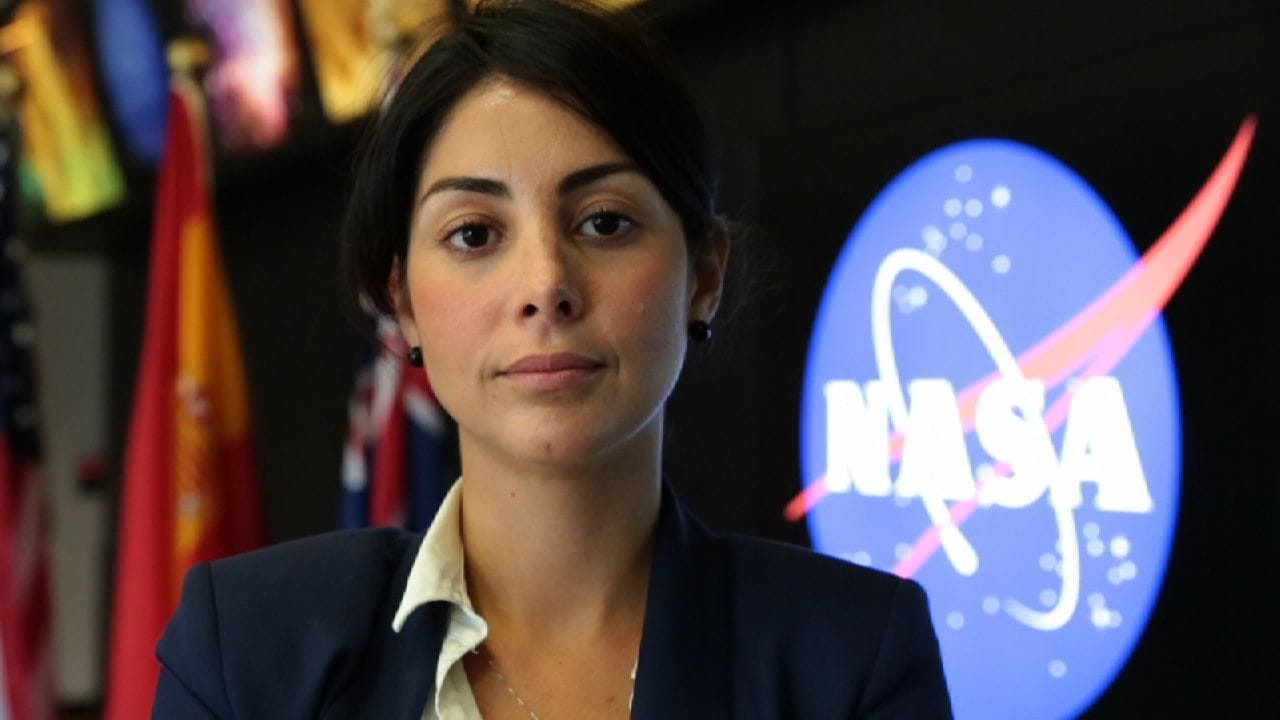
Lady Diana Trujillo Pomerantz (born 1983)[1] is a Colombian-American[2] aerospace engineer at the NASA Jet Propulsion Laboratory. (via Wikipedia)

Lady Diana Trujillo Pomerantz is a shining example of a new generation of Latina astronauts. Born in Cali, Colombia in 1981, she was named after Lady Di, who had married Prince Charles that very year. Her childhood was marked by poverty and political violence, so her solution was to lie on her back facing the stars and take her mind elsewhere.

“I would look up at the sky and enjoy the smell of the grass. I found a moment of peace. I have always been curious to learn and find answers. That's how my interest in space issues began,” she said in an interview with Infobae.

Even though her grandmother couldn’t attend school and that her mother dropped out of college, they always encouraged young Diana to pursue whatever she wanted. So, at 17 years old and with only 300 dollars to her name, she emigrated to the US. In Miami, she began cleaning houses and working at a bakery to pay for English lessons. One day, she read in a magazine about women working at NASA and something inside of her clicked. Following her childhood love for maths, she enrolled in Florida University to study aerospace engineering. Trujillo then went to Maryland University, where she took part in a robotics research team.  As a college student, she wrote an application to NASA Academy but never intended to send it. It was thanks to a friend (also Colombian) that she applied and, much to her surprise, she was the first Hispanic immigrant to be admitted in the program. 

“I started with a summer internship and had the opportunity to meet many people who did different jobs. I discovered that space activity is not just about unmanned spacecraft. I enjoyed listening to them and became passionate about being part of the space field,” she said to Infobae.

Inside NASA, Diana moved up quickly and became the leader of the Jet Propulsion Laboratory. Her bilingual abilities helped her be in charge of an international team as they planned exploration missions to Mars. She was a flight director for the Mars Perseverance rover's landing operations and made crucial engineering contributions to its robotic arm. Trujillo used her Spanish mother tongue again when she co-created #JuntosPerseveramos, the first live Spanish-language broadcast for Perseverance's arrival on Mars. She has also been selected as one of seven NASA flight directors to supervise missions to the International Space Station.

Thankfully, many Latina astronauts are working hard to bridge the gender gap. For example, Mexican-American systems engineer Christina Hernández won the Hispanic Heritage Award for Science in 2021. There’s also Clara O’Farrell, an Argentinian-American engineer specialized in fluid dynamics; Yajaira Sierra-Sastre, a Puerto Rican Ph.D. from Cornell who was selected for the HI-SEAS mission in Hawaii; Liliana Villarreal and Katya Exhazarreta, a 26-year old astronaut who became the first Mexican-born woman to travel to space with NASA. 

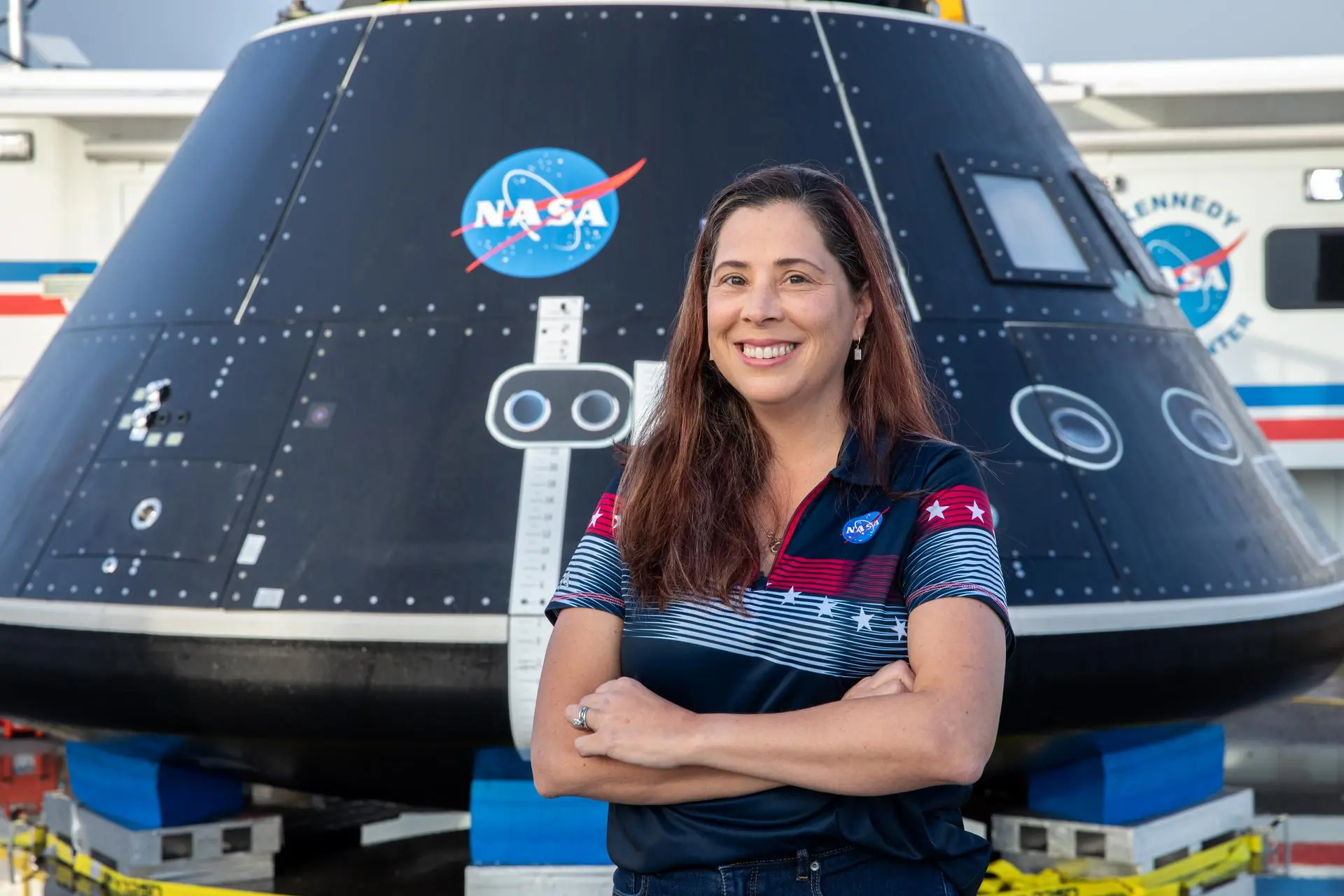
Liliana Villarreal, landing and recovery director for NASA's Artemis II April 2026 mission. (via NASA.org)

Latina astronauts like Ellen Ochoa and rising Latina leaders in engineering are redefining what’s possible in space exploration, whether on the front lines or behind the scenes missions like Artemis I bring forward Latino representation, Artemis II and knowing that tortillas made it to space on Artemis II (April 2026), we need to keep the pipeline growing.. As more Latinas enter science and engineering fields, the future of space will increasingly reflect the contributions of Latina astronauts and Latina in STEM, shaping a more inclusive frontier beyond Earth


Resumen en español

El artículo destaca el papel de las mujeres latinas en la exploración espacial y en las carreras STEM. Ellen Ochoa es la primera mujer hispana en viajar al espacio, cuya trayectoria en la NASA abrió el camino para nuevas generaciones. También está Diana Trujillo, ingeniera aeroespacial colombiana que emigró a Estados Unidos y llegó a liderar misiones clave a Marte.

Además, el artículo analiza los desafíos que aún enfrentan las latinas en STEM, como la baja representación y las desigualdades educativas, pero resalta a figuras inspiradoras que trabajan para reducir esa brecha, incluyendo a Katya Echazarreta, la primera mujer nacida en México en viajar al espacio.

Read More

Who Was Pura Belpré? The Latina Librarian Who Changed Children’s Literature

Who Was Pura Belpré? The Latina Librarian Who Changed Children’s Literature

Long before diversity in books became a movement, Pura Belpré was bringing Puerto Rican folklore to life in New York libraries. As the first Puerto Rican librarian in NYC, she created bilingual storytime and helped generations of Latino children see themselves reflected in literature.

Latina Journalists Leading the Fight for Gender Equality Across the Americas

Latina Journalists Leading the Fight for Gender Equality Across the Americas

Across the Americas, Latina journalists are reshaping the media landscape bringing visibility to gender violence, inequality, and the stories too often ignored.

Latino Artists Who Performed at the Super Bowl Halftime Show

Latino Artists Who Performed at the Super Bowl Halftime Show

Bad Bunny headlining Super Bowl. LX. and the conversation around him reveals why Latino representation in American culture still matters.

'We Didn’t Know What Was Happening’: Venezuelans Describe the Night Maduro Was Captured

'We Didn’t Know What Was Happening’: Venezuelans Describe the Night Maduro Was Captured

In the early hours of January 3, 2026, explosions woke residents across Caracas and nearby states, plunging Venezuela into uncertainty. As official media stayed silent, citizens turned to WhatsApp and social platforms. Through firsthand accounts, this story captures the fear that followed.

Join our community

Get weekly inspiration for living well delivered straight to your inbox.